Psychiactric Disability and Hannah Weiner's Typewriter Poetics
Declan Gould
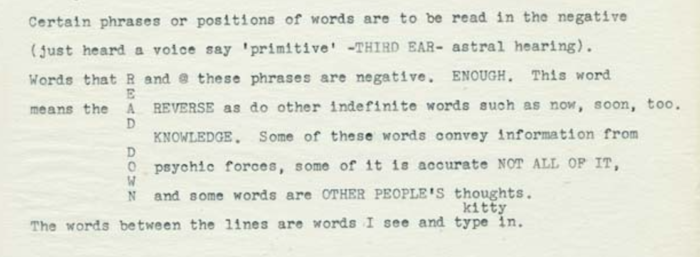
Hannah Weiner is best known for her Clairvoyant Journal, whose diaristic poems are characterized by their striking multiplicity of voices. Readers often link this polyvocality to her neurodivergence, but Weiner consistently eschewed medical labels when she discussed her writing, and instead described her experience in terms of “clairvoyance.” Weiner describes clairvoyance as the ability to: SEE / words, IN CAPITAL LETTERS, on the typewriter page, on my forehead / (very... Read more...
Grappling with Urban Cure in Brenda Coultas's “The Bowery Project”
Davy Knittle
Cure of Bodies, Cure of Cities In his 2017 collection of essays, Brilliant Imperfection: Grappling with Cure, Eli Clare critiques the language of cure as it is applied both to bodies and to ecological landscapes. Reflecting on how his understanding of cure changes over time, he writes, “I begin to understand restoration – both of ecosystems and of health – as one particular relationship between the past, present, and future.”1... Read more...
Playing with Aesthetic Distance in Disability Poetry
Jonas-Sébastien Beaudry
Why do I like it under the trees in autumn when everything is half dead? –Norma Cole1 Introduction The scaling of aesthetic distances is a helpful notion to analyze some of the work that disability poetry does. For the purpose of this essay, I understand “aesthetic distance” to denote degrees to which an audience will psychologically identify with, or dissociate itself from, the phenomenon, experience or character artistically represented before... Read more...
George Hart
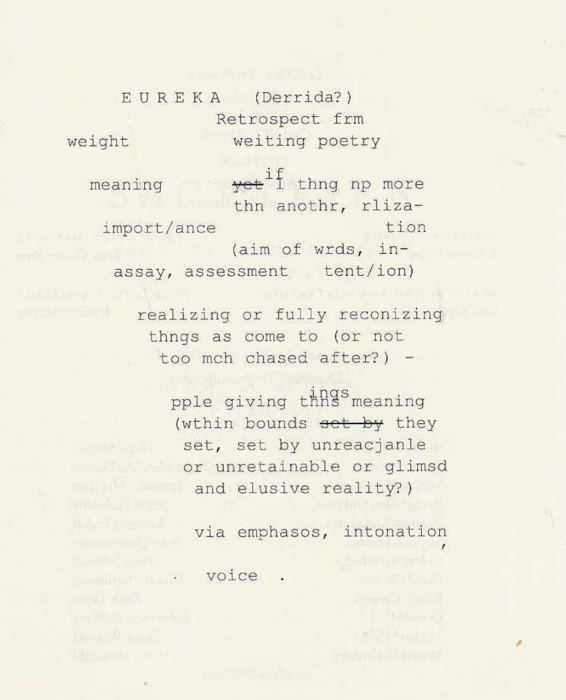
You play and feel your way by ear and eye. But always you have hindsights, if not insights –Larry Eigner, “Qs & As (?) Large and Small”1 There are many definitions of ecopoetry and ecopoetics, but none quite fit Larry Eigner’s work.2 John Kinsella goes so far as to say that he has “grave doubts that an ‘ecopoetics’ can be anything but personal.”3 If this is so, then Eigner’s... Read more...
Disability and Postphenomenological Narrative
Daniel Paul O'Brien
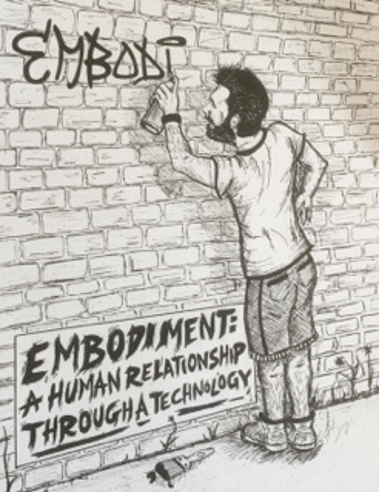
Introduction This paper considers the disability of blindness and how it has been used as an opportunity to emphasise other modes of sensuous understanding through an interactive piece of theatre. It considers the production of Flatland (2015); a pilot show created by Extant Theatre Company, which consists of blind or partially sighted members. Flatland is a show that takes place in total darkness for blind, partially, or fully sighted participants.... Read more...

The Poetics of Medical Imaging
Jessica Lewis Luck
In 1950, the poet Charles Olson published his famous essay “Projective Verse,” a text which arguably marks a shift in twentieth century poetics from the poem as an “act of the mind,” as Wallace Stevens described modern poetry, to an act of the body – engendered by the breath, the ear, and bodily movement. In his 1962 piece, “Proprioception,” Olson further elucidated the poetics of projective verse, arguing that it... Read more...

Stutter as Black/Crip Coalitional Method in Douglas Kearney's Poetics
Jessica Suzanne Stokes
Throughout his career as a poet, Cave Canem Fellow, educator, and librettist, Douglas Kearney has been invested in Black cultural creation, its multiplicity of voices (what he calls Black density/“dinsity”), and the messiness of both culture and cultural creation. In Mess and Mess and, Kearney’s 2015 book fusing poetics, personal narrative, theory, and history, he writes: “Another mess I fly to is culture. Perhaps humanity’s biggest mess, its biggest baddest... Read more...

The Poetics of Meat, Mad Cows, and Human-Animal Illness
Liz Bowen
One of the most stubborn limits of disability studies is that which encircles “the human.” We think we know what kinds of beings are exposed to ableism and stigma, as well as to the more liberatory possibilities of disability politics. With the exception of a service animal here and there, the subjects and social dynamics with which disability studies is concerned are almost always assumed to belong to homo sapiens.... Read more...

Travis Chi Wing Lau
Although pain is intangible and subjective, it is emphatically not unshareable. –Brian Hurwitz1 In 2010, I began seeking answers to what I had long felt. Through a series of appointments, X-rays and MRIs made knowledge of my body – the shadowy unknowable finally exposed by the light of the clinical gaze. The result was a series of spectral images revealing undeniable spinal deformity, growth gone wrong. The ease with... Read more...

Consuming Disability in Jillian Weise's “Elegy for Zahra Baker”
Sarah Nance
In October of 2010, a ten-year-old girl named Zahra Baker was reported missing from Hickory, a town of about 40,000 residents in Catawba County, North Carolina. The case seemed perfectly triangulated for maximum media appeal: not only was Baker a child and her own stepmother one of the earliest suspects, but Baker was also a cancer “survivor” who, as a result of both cancer and treatment, used a prosthetic leg... Read more...
