Finding Poetry in the Institutional Archive
Christine Mitchell
“Mediality,” writes Jonathan Sterne, in his format study of the mp3, “is a mundane term, like literariness; it indicates a general web of practice and reference.”1 Sterne’s aim is not to delve into literariness, but he offers the analogy2 to point out that both expressive cultural and general communicational forms exist in cross-referential modes which themselves constitute the “general condition” of their own shaping, meaning and practice. Simply stated, mediality... Read more...
Literary Archives in the 21st Century
Al Filreis, Jason Camlot, Steve Evans
Between April 26-27, 2013, the Whitney Humanities Centre at Yale University brought together a group of literary and information science scholars, historians, curators, archivists, writers, and publishers for a two-day symposium in the Beinecke Library, where they listened to papers and panel discussions and engaged in intensive discussion about the status of the literary archive in the 21st Century. Drawing on the specific perspective of their respective institutional and disciplinary... Read more...
Christine Mitchell

Jackson Mac Low's Phonopoetics
Michael Nardone
Cogs & cogs that cannot turn to recognitions: such dogs in the dark noonday! As if the tongue told & tolled Among the melancholic arcades. Where the moods advance toward the modes. Time to try the knot, the Not Or to be caught Forever in the nerve-traceries of Beauty… Unstrung, the structure is sound. –Andrew Joron, “Mazed... Read more...

Mutant Sounds, PennSound, UbuWeb, SpokenWeb
Danny Snelson
The paired qualities of contingency and dispersion inform the theoretical inflections of this page and shape the delivery of its content. The materials featured here extend a presentation given at the Approaching the Poetry Series Conference held at Concordia University on April 5, 2013. Over the course of the following essay, I consider two online collections that are likely to be well known to Amodern’s readers (PennSound and UbuWeb) alongside... Read more...
A Conversation with Shannon Mattern
Christine Mitchell, Shannon Mattern
Shannon Mattern’s broad-ranging media archaeological research, writing and teaching attend to textual and literary spaces, sound archives and the materialities of media migration and transformation. Her 2007 book on urban library design, The New Downtown Library: Designing with Communities, and in-progress manuscript projects on media archaeology and media mapping herald a multifaceted body of scholarship into the ways people encounter, uncover and engage with texts – bound and sounded, digitally... Read more...

An Operator’s Manual for Compulibratories
Dean Irvine
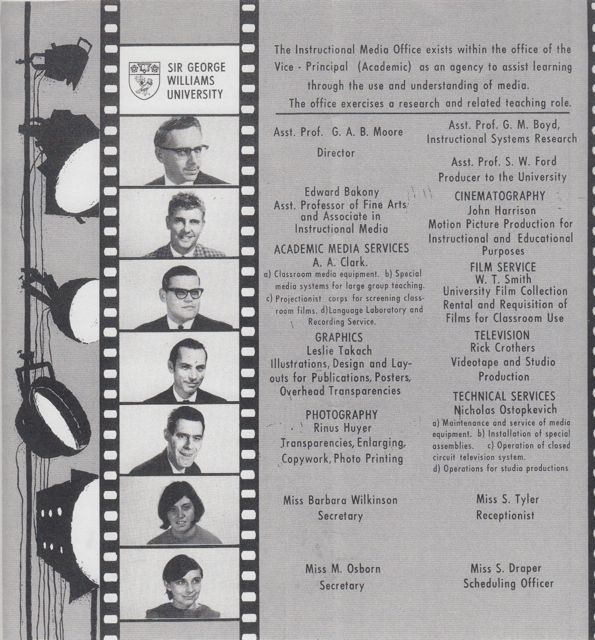
When Earle Birney came to Sir George Williams University (SGWU) to give a poetry reading in February 1968, he was at the mid-point of his year-long writer-in-residency at the University of Waterloo. According to his biographer, Elspeth Cameron, it was a miserable year.1 Written early in his residency, the ominously titled 1967 poem “1984 minus 17 & counting at u of waterloo” makes a grievance against an Orwellian campus, which... Read more...
Finding Nothing in the Avant-Garde Archive
Gregory Betts
The theme lies in the layers made and unmade by the nudging lurching spiraling down from nothing […] But still on the highest shelf of ever washed by the curve of timeless returnings lies the unreached unreachable nothing whose winds wash down to the human shores and slip shoving into each thought nudging my footsteps now as I turn to my brief night’s... Read more...
Al Filreis
The paratextual aspect of a poem as performed during a live poetry reading – its paraphonotexuality, including but not limited to what Peter Middleton calls “unplanned sound,” “obtrusive failures of attention,” and the like1 – is most readily apprehended by audiences in the prefatory remark offered by the poet. The full phonotext, to be sure, encompasses (1) the totality of sounded significations, meaning made by actualization of the “poetic voice”;... Read more...

Oral History and Literary Studies in the SpokenWeb Project
Ashley Clarkson, Steven High
When you get somebody like Ginsberg, it’s less of a poet that’s come… He’s a folk figure. He is really a cultural figure, and important as that. So whatever he does is going to be important. -George Bowering Allen Ginsberg came to Montreal as part of the Poetry Series at Sir George Williams University (now Concordia University) in November, 1969. As Ginsberg had enormous counter-cultural appeal, the organizers booked... Read more...
Muriel Rukeyser’s Meta-Poetics and the Communal Soundscape
Jane Malcolm
A person stands alone in front of an audience, holding a text and speaking in an odd voice, too regular to be conversation, too intimate and too lacking in orotundity to be a speech or a lecture, too rough and personal to be theater. The speaker is making no attempt to conceal the text. Signs of auditory effort in the audience are momentarily lost in occasional laughter, tense silences, sighs... Read more...

The Canada Council for the Arts and the Funding of Poetry Readings in Canada (1957–1977)
Cameron Anstee
The poetry reading in Canada developed into an increasingly important form of literary expression in the 1950s, 1960s, and 1970s alongside the development of literary publishing in Canada, the teaching of Canadian literature in university English departments, and the establishment of the Canada Council for the Arts. Poetry readings gained a foothold in the literary imagination of cultural agents in Canada with a scope and intensity akin to the explosion... Read more...
Jackson Mac Low Directs a Poetry Reading
Brian Reed
A woman’s voice: “Bluebirds were probably more common.” She exaggerates the stress on “blue” in “Bluebird,” pauses ever so briefly after “were,” and then rushes into the rest of the sentence fragment, emphasizing “probably.” Another person vigorously hisses, or is it static? The sound is tinny, distorted. A male voice says one word: “are.” The first voice resumes – “in the cities at one time than they are” – but... Read more...

Audio-Textual Relations in UbuWeb, PennSound and SpokenWeb
Deanna Fong
The “archival turn” of the mid–20th century produced a conceptual shift away from the archive as a mute, transparent repository, toward viewing it as process or system. Michel Foucault, who substantially contributed to the theoretical framework of this turn, described the archive as “the general system of formation and transformation of statements,” an entity whose speech and silences delineate “the law of what can be said.”1 Concurrently in literary studies,... Read more...
Some Questions of Definition
Marjorie Perloff
Is there such a thing as “The Poetry Reading Series”? In their excellent introduction to this issue of Amodern, Jason Camlot and Christine Mitchell pose two questions: “First, what is a poetry series? Second, what was The Poetry Series?” Their response – and that of their contributors – to the second question is as exciting as it is comprehensive. The authors describe the poetry series in question, which took place on the... Read more...
Jason Camlot, Darren Wershler
Introduction The literary reading series as an object of study is now more discernible than it was in the previous century. This has everything to do with the rise of networked digital media and the associated appearance of online repositories of literary recordings transferred from analog sources. With the aid of digital media, we can fruitfully approach the reading series as a literary artifact. Study lends it coherence. Search for... Read more...
Things said at, and remembered about, poetry readings, c.1966/c.2014
Jason Camlot
Selected transcriptions of extra-poetic speech from The Poetry Series, 1966-1974, and SpokenWeb oral history interviews, 2012-2014. Maxine Gadd: Oh boy. Can you hear me? I don’t know how much projection to do. I don’t know how much to talk about the poetry. My connection is very loose to the mainstream I guess, because, I don’t know, I’m just not socially related to what’s going on maybe in the poetry reading. Michael... Read more...
